Introduction
Cooling towers are a
very important part of many chemical plants. The primary task of a cooling
tower is to reject heat into the atmosphere. They represent a relatively
inexpensive and dependable means of removing low-grade heat from cooling water.
The make-up water source is used to replenish water lost to evaporation. Hot
water from heat exchangers is sent to the cooling tower. The water exits the
cooling tower and is sent back to the exchangers or to other units for further
cooling. Typical closed loop cooling tower system is shown in Figure 1.

Cooling
towers are heat exchangers that are used to dissipate large heat loads to the
atmosphere. All cooling towers operate on the principle of removing heat from
water by evaporating a small portion of the water that is re-circulated through
the unit. The heat that is removed is called latent heat of vaporization. Each
one kilogram of water that is evaporated removes approximately of 2270KJ in the
form of latent heat.
Cooling towers are huge and important parts of modern power plants with water flow rates 30000
tons per hour and more. Therefore better understanding of their performance is
the goal of many engineers and researchers at the field of heat and mass
transfer. Evaporative cooling of water in the cooling tower depends on
atmospheric conditions (temperature, humidity and wind conditions), design and
geometric parameters of the tower, and total mass flow rate of water. High
accuracy simulation of cooling tower performance can help correctly to choose many
parameters of cooling tower. Additionally, the simulation of cooling tower
performance helps significantly reduce its long and expensive testing at
variable atmospheric conditions.
Types Of Cooling Tower
Cooling
towers fall into two main categories: Natural draft and Mechanical draft.
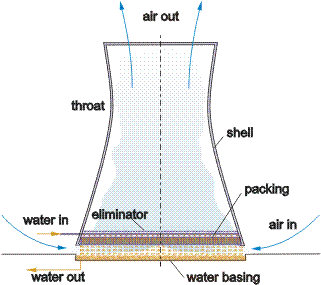
2.1 Natural draft towers use very
large concrete chimneys to introduce air through the media. Due to the large
size of these towers, they are generally used for water flow rates above 45,000
m3/hr.
These types of towers are used only by utility power stations.
2.2 Mechanical draft towers utilize
large fans to force or suck air through circulated water. The water falls
downward over fill surfaces, which help increase the contact time between the
water and the air - this helps maximize heat transfer between the two. Cooling
rates of Mechanical draft towers depend upon their fan diameter and speed of
operation. Since, the mechanical draft cooling towers are much more widely used,
the focus is on them in many industries.

The above images displays the two main type of cooling towers.
We will discuss about the whole type and their further use in chemical industry in the next segment.
Do comment and share if you like this.

No comments:
Post a Comment