Friday, 17 April 2015

Recycling of Hydrocarbons(Waste) in Catalytic Cracking

RECYCLING OF HYDROCARBONS IN CATALYTIC CRACKING

Abstract: The possibility of the chemical recycling of waste hydrocarbon fractions, e.g. waste polymers or waste lubricating oils in catalytic cracking was verified in the MAT laboratory test. Linear 1-olefins were used as model compounds simulating products of thermal pre-cracking of waste polyolefins into liquid fraction suitable for admixing to HVGO as standard FCC feed, and products of semi-pilot plant thermal/catalytic cracking of industrial PP wastes were used as possible real feed. Filtered used automotive oil was tested as possible feed to catalytic cracking to chemical recycling. 

A standard FCC catalyst was used in microactivity test at 525°C, introduction time of 40 s and catalyst/feed ratio of 4.76 g/g. No negative effect in coking was observed as consequence of olefinic fraction adding to hydrogenated VGO feed. Similarly, the use of thermally/catalytically precracked fraction in pilot-plant treatment of industrial polypropylene wastes showed good possibility of chemical recycling of waste polyolefines in FCC process into gases and gasoline fraction. Catalytic cracking of used automotive oil increased conversion to gases and gasoline with little increase of Gas Factor after longer use of this oil. Results showed good possibility for chemical recycling of waste polymers and waste lubricating oils in FCC technology into gases and gasoline. Keywords: waste plastics;

CHEMICAL RECYCLING OF WASTE HYDROCARBONS:

Waste hydrocarbons represent a serious problem in everyday life. The greatest quantities of waste hydrocarbons are mainly waste plastics and also used lubricating oils. Both these wastes come from crude oil and even if both could be used for energy production by incineration, the best way for they treatment should be the material or chemical recycling. Polymer wasted could be regarded as potential source of chemicals and energy. Different methods of polymer wastes recycling are developed [1,2]. One of the most attractive ways is chemical recycling that converts waste polymers into basic monomers or petrochemicals. About 60-70% of waste polymeric materials are composed of PE and PP that cannot be easily converted into monomers. 

For chemical recycling of waste polymers a thermal or catalytic method could be applied, by which the long alkyl chains of polymers are broken into a mixture of lighter hydrocarbons [3-20]. One of the most appropriate chemical recycling of used polyolefins is fluid catalytic cracking process that could convert waste polyolefines directly into fractions of light olefins and motor fuels. The main problem is the state of waste polyolefines – they are available in form of greater or smaller pieces or in powder – all as solids which could not be simply added to FCC feed – hydrogenated WGO. The best way to introduce the polyolefin feed to FCC process is admixing of thermally depolymerizated polymers in liquid state to the base FCC feed – hydrogenated vacuum gas oil. 

The research in this waste plastics, used oils, catalytic cracking field is focused to use of solid acid catalysts as natural or synthetic zeolites. To the main types of reactors used for the laboratory catalytic depolymerization belong batch reactor [4-6] but examples from flow-type reactors are known [7-9]. Many experiments were carried-out in thermobalances (TGA) with mixtures of about 10 wt. % of catalyst with plastics The best possibility gives laboratoty simulation of fluidized-bed reactors [3, 17-19] of MAT-tests. As heterogeneous catalysts, different mesoporous acid catalysts as conventional amorphous alumosilicates [4] and different microporous molecular sieves – zeolites of types USY [6,7,12,15,16], ZSM-5, [4-7,10-15,19] BEA [10], MOR [10] as well as mesoporous molecular sieves of MCM-41 type [8,13,14,19,20], and commercial FCC catalysts [3,15-18] were tested. 

Generally, the catalytic depolymerization is carried out over acid catalysts in atmosphere of nitrogen or other inert gas. Consequently, the cracking products are strongly non-saturated, and catalysts are deactivated because of coking. Catalytically pre-cracked polyolefines contain mainly linear and branched unsaturated and alkane molecules and aromatics. The olefins in feed represent the main different between such feed for FCC and standard feed for FCC, represented by HVGO. The paper deals with the study of the treatment of liquid and solid waste hydrocarbons – mainly waste plastics and waste lubricating oils – in catalytic cracking processes of treatment of petroleum fractions- FCC mainly to fraction of gases and motor fuels – gasoline. 2.

EXPERIMENT: In the present work the influence of additives of model compounds, representing examples of thermally depolymerizated polyethylene, were studied. As model compounds were used 1-olefines C6–C24 pure and in 10% additives to standard FCC feed – hydrogenated vacuum gas oil. Tests were carried-out in Micro-Activity Test (MAT) at 525°C. The treatment of long 1-olefins increases the total micro-activity values - conversion to gases and gasoline. As industrial example of pre-cracked polymer wastes, liquid product of thermal decomposition of polypropylene wastes in Blowdec process [21] was studied. As feed representing waste oils was tested used lubricating oil from diesel engine in bus.

Feeds: A) Hydrogenated Vacuum Gas Oil (HVGO) As feed for MAT was used a standard refinery feed for FCC from refinery - hydrogenated vacuum gas oil (HVGO). Its basic properties are summarized as

Properties of hydrogenated vacuum gas oil (HVGO): viscosity at 50°C- 43.41 mm2 /s, density (20°C)- 906 kg/m3,viscosity at 100°C-8.436 mm2 /s,melting point 40°C ,sulphur 0.033 wt. % ,nitrogen 1002 ppm wt. 10% vol,nickel 0.01 ppm wt,30% vol. vanadium ,0.07 ppm wt,50% vol. sodium 0.01 ppm wt. 70% vol. iron 0.22ppm wt. 90% vol. 541°C ED 555°C
Pure LAO - Linear alpha-olefins (Spolana Neratovice, Czech republic) with the carbon chain of 6, 8, 10, 12, 14, 16, 18, 20-24, were used as model compounds of the polyolefins thermal depolymerization. The purity of LAO was 98.4 % wt. C) Mixture of 10 wt. % of individual LAO in HVGO was prepared by mechanical mixing of HVGO and LAO at temperature of 50°.

Generally, the catalytic depolymerization is carried out over acid catalysts in atmosphere of nitrogen or other inert gas. Consequently, the cracking products are strongly non-saturated, and catalysts are deactivated because of coking. Catalytically pre-cracked polyolefines contain mainly linear and branched unsaturated and alkane molecules and aromatics. The olefins in feed represent the main different between such feed for FCC and standard feed for FCC, represented by HVGO. 

The paper deals with the study of the treatment of liquid and solid waste hydrocarbons – mainly waste plastics and waste lubricating oils – in catalytic cracking processes of treatment of petroleum fractions- FCC mainly to fraction of gases and motor fuels – gasoline. 2 mg/kg Mg 238 mg/kg Fe 61.1 mg/kg Al 25.8 mg/kg 2.2. Catalytic test For laboratory catalytic cracking tests of above-mentioned feeds was used microactivity test (MAT) according to ASTM D-3907-92 [22]. Reaction conditions in MAT: Temperature: 525°C Catalyst weight: 4.00 ±0.005 g Introduction time: 40 s Catalyst/Feed: 4.76 g/g Total flow of nitrogen: 30 ml/min 2.3. Catalyst As cracking catalyst, a commercial equilibrated FCC catalyst from refinery was used with acidity value by TPDA of 0.150 mmol of acid center/gram and surface area of 140 m2 /g. The main characteristics of used FCC catalyst are in Table 4, its SEM picture is in Figure 1. Before MAT tests, 4 g of catalyst was calcined at 560 °C for 3 hrs.

Tuesday, 14 April 2015

Cooling Tower Performance and Assessment

Now, after discussing about Components of Cooling Tower in the last Blog. Now, we will discuss about it's performance and performance assessment.

Cooling tower performance

The important parameters from point of determining the performance of cooling towers are illustrated in figure given below


                                                    Fig  Cooling tower performance chart
i)        “Range” is the difference between the cooling tower water inlet and outlet temperature.
ii)       “Approach” is the difference between the cooling tower outlet cold water temperature and ambient wet bulb temperature. Although, both range and approach should be monitored, the `Approach’ is a better indicator of cooling tower performance. (see Figure ).
iii)     Cooling tower effectiveness (in percentage) is the ratio of range, to the ideal range, i.e., difference between cooling water inlet temperature and ambient wet bulb temperature, or in other words it is = Range / (Range + Approach).
iv)      Cooling capacity is the heat rejected in kCal/hr or TR, given as product of mass flow rate of water, specific heat and temperature difference.
v)       Evaporation loss is the water quantity evaporated for cooling duty and, theoretically, for every 10,00,000 kCal heat rejected, evaporation quantity works out to 1.8 m3. An empirical relation used often is:


        Circulation Rate (m3/hr) * Temp. Difference in oC
Evaporation Loss = ----------------------------------------------------------- m3/hr
                                                   675

vi)       Cycle of concentration is the ratio of dissolved solid in circulating water to make up water

vii)     Blow down losses depend upon cycles of concentration and the evaporation losses and is given by relation:
Blow Down = Evaporation Loss / (C.O.C. – 1)

viii)     Liquid/Gas (L/G) ratio, of a cooling tower is the ratio between the water and the air mass flow rates. Against design values, seasonal variations require adjustment and tuning of water and air flow rates to get the best cooling tower effectiveness through measures like water box loading changes, blade angle adjustments.

Thermodynamics also dictate that the heat removed from the water must be equal to the heat absorbed by the surrounding air:

where: L/G = liquid to gas mass flow ratio (kg/kg) T1 = hot water temperature (0C) T2 = cold water temperature (0C) h2 = enthalpy of air-water vapor mixture at exhaust wet-bulb temperature
(same units as above) h1 = enthalpy of air-water vapor mixture at inlet wet-bulb temperature (same units as above)
Factors Affecting Cooling Tower Performance
There are some factors which affects the performance of cooling given as below.
Capacity
Heat dissipation (in kCal/hour) and circulated flow rate (m3/hr) are not sufficient to understand cooling tower performance. Other factors, which we will see, must be stated along with flow rate m3/hr. For example, a cooling tower sized to cool 4540 m3/hr through a 13.9oC range might be larger than a cooling tower to cool 4540 m3/hr through 19.5oC range.
Range
Range is determined not by the cooling tower, but by the process it is serving. The range at the exchanger is determined entirely by the heat load and the water circulation rate through the exchanger and on to the cooling water.
Range oC = Heat Load in kcals/hour / Water Circulation Rate in LPH
Thus, Range is a function of the heat load and the flow circulated through the system.
Cooling towers are usually specified to cool a certain flow rate from one temperature to another temperature at a certain wet bulb temperature. For example, the cooling tower
Cold Water Temperature 32.2oC – Wet Bulb Temperature (26.7oC) = Approach (5.5oC)
As a generalization, the closer the approach to the wet bulb, the more expensive the cooling tower due to increased size. Usually a 2.8oC approach to the design wet bulb is the coldest water temperature that cooling tower manufacturers will guarantee. If flow rate, range, approach and wet bulb had to be ranked in the order of their importance in sizing a tower, approach would be first with flow rate closely following the range and wet bulb would be of lesser importance.

Performance Assessment of Cooling Towers
In operational performance assessment, the typical measurements and observations involved are:
·        Cooling tower design data and curves to be referred as the basis.
·        Intake air WBT and DBT at each cell at ground level using a whirling pyschrometer.
·        Exhaust air WBT and DBT at each cell using a whirling psychrometer
·        CW inlet temperature at risers or top of tower, using accurate mercury in glass or a digital thermometer.
·        CW outlet temperature at full bottom, using accurate mercury in glass or a digital thermometer.
·        Process data on heat exchangers, loads on line or power plant control room readings as relevant.
·        CW flow measurement, either direct or inferred from pump motor KW and pump head and flow characteristics.
·        CT fan motor amps, volts.
·        TDS of cooling water.
·        Rated cycles of concentration at the site conditions.
·        Observations on nozzle flows, drift eliminators, condition of fills, splash bars etc.
Control of tower air flow can be done by varying methods: starting and stopping (On-Off) of fans, use of two or three speed fan motors, use of automatically adjustable pitch fans, use of variable speed fans.
On-Off fan operation of single speed fans provides the least effective control. Two speed fans provide better control with further improvement shown with three speed fans. Automatic adjustable pitch fans and variable speed fans can provide even closer control of tower cold water temperature. In multi cell towers, fans in adjacent cells may be running at different speeds or some may be on and others off depending upon the tower load and required water temperature. Depending upon the method of air volume control selected, control strategies can be determined to minimize fan energy while achieving the desired control volume of the Cold water temperature. 

Components of Cooling Tower

So, continuing with the discussion of Cooling tower, in this blog we will discuss about the component used to manufacture a established and well framed Cooling tower. 

Components of Cooling Tower


·         Frame and casing: Most towers have structural frames that support the exterior enclosures (casings), motors, fans, and other components. With some smaller designs, such as some glass fiber units, the casing may essentially be the frame.
·     
        Fill: Most towers employ fills (made of plastic or wood) to facilitate heat transfer by maximizing water and air contact. Fill can either be splash or film type.

With splash fill, water falls over successive layers of horizontal splash bars, continuously breaking into smaller droplets, while also wetting the fill surface. Plastic splash fill promotes better heat transfer than the wood splash fill.

Film fill consists of thin, closely spaced plastic surfaces over which the water spreads, forming a thin film in contact with the air. These surfaces may be flat, corrugated, honeycombed, or other patterns. The film type of fill is the more efficient and provides same heat transfer in a smaller volume than the splash fill.
·     
        Cold water basin: The cold water basin, located at or near the bottom of the tower, receives the cooled water that flows down through the tower and fill. The basin usually has a sump or low point for the cold water discharge connection. In many tower designs, the cold water basin is beneath the entire fill.

In some forced draft counter flow design, however, the water at the bottom of the fill is channeled to a perimeter trough that functions as the cold water basin. Propeller fans are mounted beneath the fill to blow the air up through the tower. With this design, the tower is mounted on legs, providing easy access to the fans and their motors.
·   
            Drift eliminators: These capture water droplets entrapped in the air stream that otherwise would be lost to the atmosphere.
·   
             Air inlet: This is the point of entry for the air entering a tower. The inlet may take up an entire side   of a tower—cross flow design— or be located low on the side or the bottom of counter flow designs.
·    
          Louvers: Generally, cross-flow towers have inlet louvers. The purpose of louvers is to equalize air flow into the fill and retain the water within the tower. Many counter flow tower designs do not require louvers.
·      
           Nozzles: These provide the water sprays to wet the fill. Uniform water distribution at the top of the fill is essential to achieve proper wetting of the entire fill surface. Nozzles can either be fixed in place and have either round or square spray patterns or can be part of a rotating assembly as found in some circular cross-section towers.
·      
            Fans: Both axial (propeller type) and centrifugal fans are used in towers. Generally, propeller fans are used in induced draft towers and both propeller and centrifugal fans are found in forced draft towers. Depending upon their size, propeller fans can either be fixed or variable pitch.

A fan having non-automatic adjustable pitch blades permits the same fan to be used over a wide range of kWs with the fan adjusted to deliver the desired air flow at the lowest power consumption.


Automatic variable pitch blades can vary air flow in response to changing load conditions.

Thursday, 9 April 2015

Save Tree- Save Life


Do you think you can do this?


"What does he plant who plants a tree?
He plants the friend of sun and sky;
He plants the flag of breezes free;
The shaft of beauty, towering high,
he plants a home to heaven a neigh.
For song and mother-croon of bird
in hushed and happy twilight heard -
The treble of heaven's harmony.
These things he plants who plants a tree."


A small try to save the trees so that we can sustain more and have free air for our coming generations.

Nadeem Ahmed


Wednesday, 8 April 2015

INTRODUCTION TO INDUSTRIAL COOLING TOWER

Introduction
 Cooling towers are a very important part of many chemical plants. The primary task of a cooling tower is to reject heat into the atmosphere. They represent a relatively inexpensive and dependable means of removing low-grade heat from cooling water. The make-up water source is used to replenish water lost to evaporation. Hot water from heat exchangers is sent to the cooling tower. The water exits the cooling tower and is sent back to the exchangers or to other units for further cooling. Typical closed loop cooling tower system is shown in Figure 1.


Cooling towers are heat exchangers that are used to dissipate large heat loads to the atmosphere. All cooling towers operate on the principle of removing heat from water by evaporating a small portion of the water that is re-circulated through the unit. The heat that is removed is called latent heat of vaporization. Each one kilogram of water that is evaporated removes approximately of 2270KJ in the form of latent heat.


Cooling towers are huge and important parts of modern power plants with water flow rates 30000 tons per hour and more. Therefore better understanding of their performance is the goal of many engineers and researchers at the field of heat and mass transfer. Evaporative cooling of water in the cooling tower depends on atmospheric conditions (temperature, humidity and wind conditions), design and geometric parameters of the tower, and total mass flow rate of water. High accuracy simulation of cooling tower performance can help correctly to choose many parameters of cooling tower. Additionally, the simulation of cooling tower performance helps significantly reduce its long and expensive testing at variable atmospheric conditions.

Types Of Cooling Tower

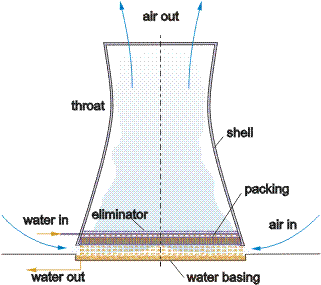
Cooling towers fall into two main categories: Natural draft and Mechanical draft.

2.1 Natural draft towers use very large concrete chimneys to introduce air through the media. Due to the large size of these towers, they are generally used for water flow rates above 45,000 m3/hr. These types of towers are used only by utility power stations.

2.2 Mechanical draft towers utilize large fans to force or suck air through circulated water. The water falls downward over fill surfaces, which help increase the contact time between the water and the air - this helps maximize heat transfer between the two. Cooling rates of Mechanical draft towers depend upon their fan diameter and speed of operation. Since, the mechanical draft cooling towers are much more widely used, the focus is on them in many industries.


The above images displays the two main type of cooling towers.
We will discuss about the whole type and their further use in chemical industry in the next segment.
Do comment and share if you like this.

Tuesday, 7 April 2015

OPTIMAL DESIGN PROBLEM SOLUTION

OPTIMAL PROBLEM FORMULATION

So continuing with the last discussion of optimization, we discussed about “WHAT IS OPTIMIZATION”. Now we will discuss about the use of algorithm and OPTIMAL PROBLEM FORMULATION.

As, I have already told that in many industrial design activities, a naïve optimal design is achieved by comparing a few (limited upto ten or more) alternative design solution are created by using a priori problem knowledge.

In this activity, we first investigate the feasibility of each design solution and thereafter an estimate of the underlying objective (cost, profit etc.) of each design is calculated and we ended with adopting the best design solution.

We follow this method because of the limitation of resources and time and also because of the lack of knowledge of existing optimization procedure.

So, we need the design procedure or algorithm in order to solve it systematically and come up with better solutions in terms of the chosen objective- cost, efficiency, safety, or others aspects.

Now, we will begin our discussion with the formulation procedure by bringing into your notice that it is almost impossible to apply a single formulation procedure for all engineering design problems.

Since objective of designing the variable vary from product to product, different techniques need to be used in different problems. Purpose of this formulation procedure is to create a mathematical model of the optimal design problem, which then can be solved using an optimization algorithm. Since an optimization algorithm accepts an optimization problem in a particular format, every optimal design problem must be formulated in that format.  


Monday, 6 April 2015

Introduction to Optimization

OPTIMIZATION

There are lot of difficulties faced by Engineers and Researchers in industries and academic to understand the role of optimization in engineering design. To many of them, optimization is an esoteric technique used only in mathematics and operations research related activities.

It is primarily used in design activities in which the goal is not only to achieve just a feasible design, but also a design objective.

In simple manner a beginner can understand it as a process of minima or maxima (of feed) just to achieve the Maximum Product or Feasible design which can achieve the more profit for an Industry or Researcher.

To start Optimization process we need an Algorithm process.

An optimization algorithm is a procedure which is executed iteratively by comparing various solutions till the optimum or a satisfactory solution is found.

For an industrial design purpose, if there are designs previously available so we can compare them to have the optimal solution. This is another way of optimization, but this simplistic approach never guarantees an optimal solution.

These algorithms are becoming increasingly popular in engineering design activities, primarily because of the availability and affordability of high speed computers.

For example:- 
1. In Aerospace design, algorithms are used to minimize the weight and every component adds to the overall weight of the aircraft.

2. In chemical industry for the design of Dryer, reactor and other equipment, algorithms are used and they a profitable weight for Industry.

Sunday, 5 April 2015

INDUSTRIAL FILTRATION OR CHEMICAL INDUSTRIES FILTRATION

Industrial Filtration

Filtration is the removal of solid particles from a fluid by passing the fluid through a filtering medium, or ‘septum’ on which the solid are deposited.

Industrial filtrations range from simple straining to highly complex separations.

Firstly the feed is modified by some means of pretreatment i.e. heating, or adding a ‘filter aid’ such as cellulose, to increase filtration rate. In industrial filtration the solid content of the feed ranges from a trace to a very high percentage.

Fluid flows through a filter medium by virtue of a pressure differential across the medium. Pressures above atmospheric may be developed by the force of gravity acting on a column of liquid, by a pump or blower, or by centrifugal force .

Types of Industrial Filters: -

These are mainly divided into three main groups: 
Cake Filters, Clarifying Filters, and Cross flow Filters.

Cake filters: - They separate relatively large amount of solids as a cake of crystals and sludge. Before the discharge of filtered fluid, they often include provision for washing the cake and for removing some of the liquid from the solids.

Clarifying filters: - They are operated to produce a clean gas or sparkling clear liquid such as beverages (cold drinks & juices). They remove small amount and size of solids, which are trapped inside the filter medium, or on its external surfaces.     

Crossflow filters: - In this type of filters the feed suspension flows under pressure at a fairly high velocity across the filter medium. A thin layer of solid may form on the surface of the medium, but the high liquid velocity keeps the layer from building up.

The filter medium is a ceramic, metal, or polymer membrane with pores small enough to exclude most of the suspended particles.